Vaping has grown rapidly over the last decade, becoming the most popular consumer competition to cigarettes, and the most common product used to quit smoking. But along with its increased popularity has come a troublesome group of customers: curious teenagers. Regulators and legislators have used a variety of strategies to keep adolescents away from vapor products, and by far the most common has been regulating how old you have to be to buy vape products.
As with alcohol, enforcing a legal minimum sales age for e-cigarettes isn’t a perfect solution, but it is the most reliable way to reduce teen vaping. For legislators, deciding how old you have to be to vape, how old to buy a vape, the penalties for retailers who break the law, and how to enforce an age-to-purchase law isn't easy. After all, lawmakers who get it wrong may accidentally increase youth or adult smoking, or help create a black market.
In most countries, vaping is either regulated as a tobacco product, as part of a standalone consumer product category, or isn’t specifically regulated at all. In some countries, vapor products are banned. In the nations that regulate e-cigarettes, the legal age to buy them is usually the same age at which citizens are considered adults. In most countries, that age is 18, but it varies, as we will see. In the United States—the largest vaping market in the world—the legal vaping age is now 21.
What is the legal age to buy vapes in the U.S.?
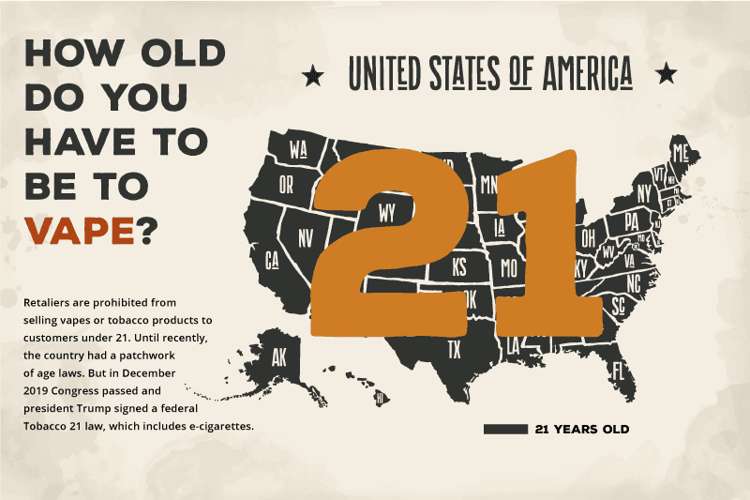
Facing pressure from tobacco control groups and concerned parents, Congress passed a federal Tobacco 21 law in December 2019. The new measure, included in the year-end federal appropriations bill, was signed into law by President Trump on Dec. 20, and took effect immediately. Although it covers cigarettes and other tobacco products, the impetus to pass the law came from concern over teen vaping.
The bill adds a line to the Food, Drug and Cosmetic Act stating that it “shall be unlawful for any retailer to sell a tobacco product to any person younger than 21 years of age.” It mandates that each state must show that the age limit is being enforced—even if the state itself has not passed its own Tobacco 21 law—or risk losing part of its federal substance abuse matching grants.
The new law does not impose penalties for purchase, use or possession (often called “PUP laws”) by those under 21 (although states and municipalities are free to add those laws), but only for retailers who sell to underage patrons. Current local laws that exempt certain groups (active-duty military members, for example) are now preempted by the federal law, which has no such exemptions.
The push for Tobacco 21 laws
Part of the Food and Drug Administration’s 2016 Deeming Rule was a federal ban on the sales of vapor products to those under age 18. By deeming the tobacco-free devices and e-liquids to be tobacco products, they automatically fell under the existing federal restriction on selling tobacco products to minors. The minimum age to purchase vapes had been a major demand of tobacco control activists, who had long portrayed the vaping market as a “wild west” that needed taming by the FDA. The truth is less exciting: 48 states already had their own age restrictions by the time the federal agency acted.
But even before the federal age restriction in the Deeming Rule took effect in May 2016, tobacco control groups had begun aiming higher. New York City implemented the first so-called Tobacco 21 law in 2014. In 2016, Hawaii became the first state to do it, and California followed later that year. By the time Congress passed the federal law, 19 states and more than 500 cities and counties had imposed T-21 restrictions.
Proponents of increasing the legal age beyond 18 said that if young potential smokers (or vapers) didn’t regularly socialize with people old enough to legally purchase tobacco or vaping products, fewer teenagers would have access and become regular users. Many high school seniors are 18, they said. Those young adults are able to legally buy the products, which they then share with or sell to the younger students. But few high school students have 21-year-old friends.
However, the Family Smoking Prevention and Tobacco Control Act prevented the FDA from increasing the legal age to buy tobacco beyond 18, the legal age of majority. Until they could persuade Congress to amend the law, anti-smoking groups decided to lobby cities and states to pass their own age limits. And that’s exactly what they did.
When Congress finally passed Tobacco 21 in December 2019, there was no opposition.
For one organization, increasing the age to purchase tobacco products has been its sole purpose. Founded by an Ohio State University medical professor, Tobacco 21 and its parent organization the Preventing Tobacco Addiction Foundation not only oppose smoking, but also maintain a zero-tolerance policy toward vaping. According to nicotine consumer advocacy group CASAA, “advocates of T-21 legislation have as their guiding principle the eventual elimination of tobacco and nicotine products from the marketplace.”
In fact, Tobacco 21 founder Rob Crane actually opposed laws that would increase the legal age to buy cigarettes if they exempted vaping products. The Tobacco 21 website says the organization only supports “an increase to age 21 for tobacco products if it also includes e-cigarettes and other nicotine products without exemption or preemption of increased local control.”
The 2018-19 vaping moral panic, which centered around teenage use of the popular JUUL pod vape, brought about intensified efforts to ban vapor sales to minors. The 2019 state legislative session produced T-21 proposals in dozens of states. The demand for a federal law had reached a tipping point. When Congress finally passed Tobacco 21 in December 2019, there was no serious opposition.
Passage of Tobacco 21 doesn’t mean all 18- to 20-year-olds will stop vaping or smoking. Many young adults will choose whichever nicotine product is easiest to obtain, which may very well be cigarettes. According to one study, increasing the minimum legal sales age for vaping products is likely to send a significant number of young adult vapers to cigarettes.
The legal age to buy zero-nicotine products
The Deeming Rule defines e-cigarettes and e-liquid as tobacco products, or components or parts of tobacco products. Because components and parts can be used to modify the performance of a “finished product,” they’re also regulated as tobacco products.
As long as zero-nicotine e-liquid can be used with a product (like a mod or atomizer) that can also be used with nicotine-containing e-juice, it is regulated the same way. It may sound foolish, but that’s how the FDA justified including items like atomizer coils, batteries, and computer software in its definition of tobacco products.
Because it is defined as a tobacco product, it is illegal for a retailer to sell zero-nicotine e-liquid to anyone under 21.
These regulations don’t apply to every nicotine-free product, though. For example, caffeine pouches may resemble nicotine pouches, but they aren’t classified as tobacco products simply because of the pouch format. As of 2026, there is no federal minimum age to buy caffeine pouches
The age to vape in countries around the world
Aside from countries that have banned vapes, and those that have no vaping regulations, most nations simply use the legal adult age to set the minimum age to buy vapor products (and other adult products).
Some countries have a national legal age, but individual states or provinces are allowed to set legal ages that are higher. Canada, for example, has a national minimum age of 18, but many provinces and territories have set 19 as the age to buy vaping products. In Australia, sales of nicotine-containing consumer products (except cigarettes) are illegal without a doctor's prescription, but non-nicotine vapes are allowed, and the age to purchase varies from state to state.
If you’re planning on traveling to another country with your vaping products, it's wise to check with authorities in that country before you leave to find the most recent information on vaping laws and practices.
Age 18
- Belgium
- Bhutan
- Brazil
- Bulgaria
- Canada
- China
- Costa Rica
- Croatia
- Cyprus
- Denmark
- Ecuador
- England
- El Salvador
- Estonia
- Fiji
- Finland
- France
- Georgia
- Germany
- Greece
- Ireland
- Israel
- Italy
- Ivory Coast
- Liechtenstein
- Lithuania
- Luxembourg
- Malaysia
- Maldives
- Malta
- Moldova
- Netherlands
- New Zealand
- Norway
- Papua New Guinea
- Paraguay
- Poland
- Portugal
- San Marino
- Saudi Arabia
- Scotland
- Senegal
- Slovenia
- South Africa
- Sweden
- Tajikistan
- Togo
- Tuvalu
- Ukraine
- Vietnam
- Wales
Age 19
- Jordan
- Republic of Korea (South Korea)
- Turkey
Age 20
- Japan
- Latvia
Age 21
- Ethiopia
- Guam
- Honduras
- Indonesia
- Niue
- Palau
- Philippines
- United States
(Sources: Johns Hopkins University's Global Tobacco Control site; the Knowledge-Action-Change Global State of Tobacco Harm Reduction site; and original research.)
Who knows when adulthood begins?
No one knows when adolescence ends and adulthood begins. In fact, it’s different for every person. But legislators must decide on a legal age of majority—the age at which a young person is allowed to vote, enter contracts, apply for credit, serve in the military, and buy alcohol, tobacco, and other products considered inappropriate for children.
Legislators try to choose an age at which most young people have more adult traits than adolescent ones. The age is always a compromise, but it recognizes that we grant adults liberty to make many choices that involve risk. Tobacco 21 is an extraordinary law because it judges smoking (and vaping) to be so risky that the choice to do it must be taken away from young adults who are trusted to drive a car, buy a house, get married, go skydiving, or fight in a war. Most countries around the world have not found sufficient evidence to support the need for such an extreme measure.


Germany approves higher taxes on e-liquid, heated tobacco, and cigarettes, with vape liquid duty rising to €0.44/ml by 2030.

Indiana clears 257 MR FOG and 77 Lost Mary vape entries for sale after initially ordering retailers to remove several Chinese-linked brands.

Sweden’s government deadlock could delay EU nicotine tax negotiations as its opposition to higher minimum taxes on nicotine pouches remains uncertain.

FDA announces four new tobacco advisory committee members and seeks nominations for two additional voting positions by Dec. 14, 2026.

The OXVA VPRIME 2 delivers sub ohm performance in a pod-style device. Read our review to learn about its upgrades, size, battery life, flavor, and more.

Check out our OXVA XLIM 4 and XLIM PRO 4 review to learn about the new UNITECH 3.0 pods and the incredibly innovative anti-burn tech (ABT).
The DOJO BLAST X combines a 10 mL refill system, a dual-mesh coil, and a 1000 mAh battery. Is it needlessly confusing? Read our review to find out.
The Lost Mary BM6000 is a pre-filled pod vape that pairs a 2 mL pod with a 10 mL refill container and a QUAQ mesh coil. Read our review to learn more.