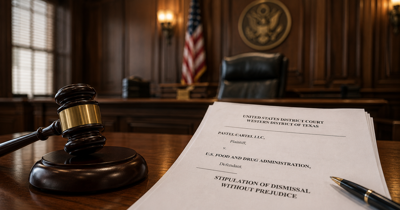
A federal appeals court has handed several vaping companies a major victory. It ruled that the FDA unlawfully imposed a key standard used to deny marketing applications for vaping products without first following the rulemaking process required by federal law.
In an Aug. 19 decision, a three-judge panel of the U.S. Court of Appeals for the Fifth Circuit granted petitions filed by NicQuid and other vaping businesses, vacated the FDA’s marketing denial orders (MDOs), and sent the cases back to the agency for further proceedings.
The ruling centers on the FDA’s “comparative efficacy” standard. Under that standard, applicants seeking authorization for non-tobacco-flavored vaping products are required to show that their products offer greater benefits to adult smokers than tobacco-flavored products. Those benefits must outweigh the additional risks the agency says flavored products pose to young people.
The court didn’t rule that the FDA is prohibited from making such comparisons. Instead, the judges concluded that the agency turned the comparative efficacy requirement into a binding rule affecting potentially huge numbers of applicants. The FDA did so without using the notice-and-comment rulemaking process required by the Administrative Procedure Act (APA).
“We hold that FDA’s comparative efficacy standard amounts to a substantive rule, and that its adoption through informal adjudication contravenes the APA’s notice-and-comment rulemaking requirement,” Judge Jerry E. Smith wrote for the court.
Court says FDA created a rule behind closed doors
NicQuid submitted premarket tobacco product applications (PMTAs) in 2020 for several e-liquids, including Menthol Blend, Strawberry Peach, Spearmint, and Sweet Leaf. The FDA issued an MDO in May 2024, concluding that NicQuid had failed to provide sufficient evidence that the benefits its flavored products offered adult users outweighed their risks to youth. The agency pointed in particular to the absence of a randomized controlled trial, longitudinal cohort study, or other evidence that could reliably compare switching or cigarette reduction among users of the flavored products with users of tobacco-flavored products.
NicQuid and the other petitioners argued that the FDA wasn’t simply evaluating applications individually. They said the agency had effectively established a binding evidentiary requirement that FDA reviewers applied across PMTAs without first establishing that requirement through formal rulemaking. The Fifth Circuit agreed, concluding that the comparative efficacy standard “binds the agency to its enforcement position, prospectively applies to an unbounded set of applicants, and amounts to a de facto ban.” The judges also pointed to internal FDA memoranda as evidence that the agency developed the policy internally and then imposed it during individual PMTA reviews.
“Instead of originating in a specific adjudication or order, it is most plausible to say that the comparative efficacy standard was born in internal agency policymaking and was then publicly debuted in an adjudication rather than through notice-and-comment,” Smith wrote. The court described the procedural violation in unusually blunt terms, agreeing with an earlier Fifth Circuit panel that the issue was “not a close call.”
More than a million flavored products were denied
The scale of the FDA’s PMTA denials played an important role in the court’s reasoning. The opinion notes that the FDA had issued MDOs covering more than 1.2 million flavored ENDS products, while receiving applications for more than six million vaping products overall. The judges questioned whether such a huge number of applications could genuinely have been independently assessed under materially identical circumstances.
“It is implausible that more than one million MDOs could have materially indistinguishable facts,” the court said. Instead, the judges said the record better supported the conclusion that the FDA had used a “check-the-box exercise” for non-tobacco-flavored applications (“if it lacks an RCT, automatically deny”). Without the comparative efficacy evidence the agency expected, the applications were denied.
The court also noted the strikingly small number of flavored products that have successfully passed the FDA review process. At the time of the figures cited in the opinion, the agency had received applications covering more than six million ENDS products but authorized only 45 of any variety.
The decision follows years of battles over FDA vape denials
The ruling is the latest chapter in a years-long series of legal challenges to the FDA’s handling of vaping product applications. The Fifth Circuit granted NicQuid a stay of its MDO in August 2024 while the company challenged the denial. Several of the cases decided Wednesday were later consolidated, including petitions involving Breeze Smoke, Vertigo Vapor (Baton Vapor), Lead by Sales (White Cloud Cigarettes), Vapermate, Elite Brothers, and American Vapor Company.
The legal landscape changed substantially while those cases were pending. In April 2025, the Supreme Court reversed an earlier Fifth Circuit victory for Triton Distribution and Vapetasia in FDA v. Wages & White Lion Investments. The Supreme Court rejected arguments that the FDA had improperly changed its position on the evidence needed to support PMTAs for flavored products. But it did not decide the separate question at the center of Wednesday’s ruling: whether the FDA’s comparative efficacy policy amounted to a substantive rule that had to be adopted through the APA’s notice-and-comment process. The Fifth Circuit has now answered that question. According to the panel, it does.
What happens now?
The ruling does not mean the Fifth Circuit authorized NicQuid’s products, nor does it prevent the FDA from considering comparative evidence when reviewing vaping products. Instead, the court vacated the challenged FDA orders and returned the cases to the agency.
The FDA now has several options. The court said the agency could rethink the comparative efficacy rule, formally adopt it using the APA’s notice-and-comment procedure (which would allow affected businesses and other interested parties to submit comments), or take other action consistent with the court’s decision.
The Fifth Circuit has not ruled that flavored vaping products automatically satisfy the Tobacco Control Act’s “appropriate for the protection of the public health” (APPH) standard. It has ruled that the FDA cannot establish a binding, prospective regulatory requirement affecting an open-ended group of applicants through internal policymaking. The agency cannot then enforce that requirement through individual application decisions without following the procedures required for substantive rules.
For the vaping industry, that could make Wednesday’s decision important well beyond the companies whose MDOs were directly before the court. Exactly how far the effects will reach, however, will depend on what the FDA does next and whether the government seeks further review of the Fifth Circuit’s decision.


Because of declining cigarette sales, state governments in the U.S. and countries around the world are looking to vapor products as a new source of tax revenue.

A list of vaping product flavor bans and online sales bans in the United States, and sales and possession bans in other countries.

A closer look at PouchPoint, an online nicotine pouch store offering competitive pricing, wide selection, and a smooth shopping experience.

A practical, data-driven breakdown of where the vape market is heading—and how to position your business ahead of regulatory and category shifts.