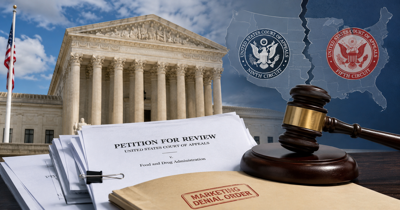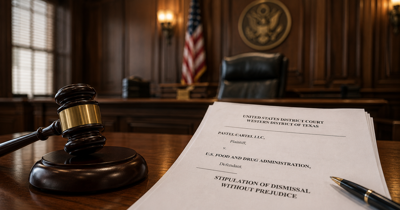
A federal appeals court has rejected MH Global LLC's challenge to FDA marketing denial orders (MDOs) for flavored vaping products, backing the agency's requirement that applicants show flavored products offer benefits beyond tobacco-flavored alternatives.
The Aug. 18 Ninth Circuit decision comes amid a remarkable split between federal appeals courts over how the Food and Drug Administration can apply its flavored-vape premarket review standard. Just one day after the MH Global decision, the Fifth Circuit reached the opposite conclusion on a crucial procedural question.
MH Global, which does business as Streamline Vape Co., challenged the FDA's denial of its premarket tobacco product applications (PMTAs). The Ninth Circuit said the Tobacco Control Act allows the agency to demand reliable, product-specific evidence showing that flavored products produce greater smoking-cessation or switching benefits than tobacco-flavored products.
The FDA had concluded that MH Global didn't provide evidence showing its flavored products offered additional benefits sufficient to outweigh what the agency considers increased youth-initiation risks. According to the court, MH Global supplied no randomized controlled trial, longitudinal study, or similarly robust evidence establishing a comparative advantage.
That approach reflects the FDA's "comparative efficacy" standard. An FDA technical review document describing the agency's approach to flavored electronic nicotine delivery systems (ENDS) says evidence must be sufficiently reliable and robust to demonstrate that potential benefits to adult smokers outweigh risks to youth.
MH Global also argued that the FDA could not impose the comparative-efficacy requirement without first going through notice-and-comment rulemaking. The Ninth Circuit rejected that argument, relying heavily on its Aug. 10 published decision in Drip More LLC v. FDA.
In Drip More, the Ninth Circuit held that the FDA could apply comparative efficacy when deciding individual PMTAs without first creating the standard through formal rulemaking. The court characterized the requirement as part of the agency's application of the Tobacco Control Act's "appropriate for the protection of the public health" standard.
But the Fifth Circuit has now gone the other way.
In an Aug. 19 decision involving NicQuid and six other consolidated challenges, a three-judge Fifth Circuit panel concluded that the FDA's comparative-efficacy requirement operates as a substantive rule affecting an open-ended group of applicants. The court said the agency therefore had to use the Administrative Procedure Act's notice-and-comment rulemaking process before enforcing it.
The Fifth Circuit granted the companies' petitions, vacated their MDOs, and sent the applications back to the FDA.
The disagreement concerns an issue the Supreme Court deliberately left unresolved. In its April 2025 decision in FDA v. Wages & White Lion Investments, the Supreme Court largely backed the FDA against Triton Distribution and Vapetasia but did not decide whether the comparative-efficacy policy was a substantive rule requiring notice-and-comment procedures.
The MH Global decision itself is unpublished and nonprecedential. But Drip More is a published Ninth Circuit opinion and establishes the rule within that circuit. The Fifth Circuit has now adopted the opposite position on the Administrative Procedure Act question, leaving FDA's flavored-vape review policy subject to conflicting federal appellate interpretations.


CBG (cannabigerol) is the mother of all cannabinoids, including CBD and THC. Learn more about CBG flower, its effects, strains, and whether it can get you high.

Learn how old you have to be to buy caffeine pouches, including federal and state age restrictions, retailer policies, and rules for minors.
Learn whether caffeine pouches are safe, including potential side effects, caffeine limits, oral health risks, and who should avoid them.

Because of declining cigarette sales, state governments in the U.S. and countries around the world are looking to vapor products as a new source of tax revenue.