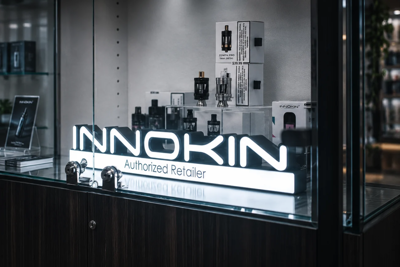
Innokin has provided its most detailed explanation yet for removing co-founder George Xia from two of its highest-ranking positions. The company said complaints from key customers, employee dissatisfaction, and management decisions that reportedly caused substantial financial losses contributed to the leadership shake-up.
In written responses to questions submitted by Vaping360, the Shenzhen-based manufacturer said its board had reviewed Xia's performance following concerns about the company's business strategy, customer relationships, and operational management. The company also acknowledged broader strategic mistakes, including its response to the growth of disposable vapes, which it says weakened its competitive position in recent years.
The revelations come four months after Innokin announced two major leadership changes within just six days. On July 10, the company confirmed that Xia had ceased serving as chairman following an extraordinary board meeting, with Li Gen appointed as his replacement. A second extraordinary meeting on July 16 resulted in Xia also leaving his position as deputy general manager responsible for business operations. Neither announcement explained the reasons behind the decisions, leaving questions about the future direction of one of the industry's longest-established hardware manufacturers.
Innokin's new responses now provide a clearer picture of the circumstances surrounding those changes and the wider restructuring taking place within the company.
Customer complaints and management failures behind Xia's removal
According to Innokin, the board's decision was influenced by several factors, including customer complaints, employee feedback, and the company's commercial performance in recent years. The company said several important customers had expressed dissatisfaction with Xia's management and the customer service operations he supervised. One customer reportedly submitted a formal complaint by email, criticizing Innokin's business strategy and management, even using a Chinese proverb about poor leadership affecting an entire organization to express their frustration.
The board subsequently reviewed the concerns alongside feedback from employees, many of whom had also reportedly expressed dissatisfaction with Xia's handling of daily operations.
"The board found that some of the sales policies introduced while George oversaw the business were serious mistakes and led to substantial losses for Innokin."
It added that these issues had strained relationships with important customers and seriously damaged the manufacturer's reputation.
Innokin did not disclose the financial scale of those losses, identify the customers involved, or provide specific examples of the policies in question. Nevertheless, the statements represent an unusually direct public criticism of the management decisions associated with one of the company's own founders.
The significance of the decision extends beyond an ordinary executive departure. Xia was one of Innokin's three founding shareholders and had played a prominent role in the company's development since its establishment in 2011. Innokin confirmed that its board unanimously decided he should no longer serve as chairman or deputy general manager. Xia subsequently submitted his resignation as a director. However, he will continue fulfilling his responsibilities in that position until a replacement takes office, in accordance with the company's Articles of Association. He also retains his status as a shareholder.
Innokin explained that the two extraordinary board meetings were held separately because they addressed different levels of responsibility. The first concerned the chairmanship and the handover of board-level duties, while the second dealt with the transfer of responsibility for day-to-day business operations. The company also said that James and Jimi, its other two founding shareholders, helped address the issues identified during the management review and supported the board's decisions.
The account makes clear that Innokin considers Xia's removal part of a necessary management change, although the company has not provided documentary evidence supporting the allegations or disclosed whether Xia disputes its assessment.
Innokin admits it misjudged the disposable vape market
Beyond the leadership changes, Innokin offered a revealing assessment of its commercial performance and the strategic decisions that affected its position in the vaping industry. The company acknowledged that it underestimated both how quickly disposable vapes would become popular and how long that demand would last.
For a manufacturer whose reputation was built largely around refillable devices, tanks, and other open-system products, the rapid growth of disposables presented a significant challenge. Innokin initially believed that environmental concerns, the higher long-term cost of disposables, and expected regulatory intervention would cause the category's popularity to decline sooner than it ultimately did.
"In hindsight, we underestimated how quickly consumers would take to disposables and how long that demand would last."
The company said it initially continued focusing its development efforts on open-system products because it expected disposable demand to cool. When that didn't happen, pressure on its traditional product categories became greater and more prolonged than anticipated. Innokin subsequently attempted to respond by investing more heavily in disposable products, but those efforts introduced additional challenges. The manufacturer said it struggled to develop devices that met its own innovation expectations while addressing what it saw as the category's inherent shortcomings.
Innokin acknowledged that trying to compete across both segments affected its development priorities and ultimately weakened its market position.
"As our development efforts became spread across both categories, our investment in core open-system products was affected, and our competitive position weakened."
It also conceded that its product strategy had lost focus during this period. These admissions provide important context for Innokin's reduced prominence in recent years, particularly when compared with the influence of earlier products such as the Endura, Coolfire, and Zenith ranges. Although the company continued introducing new hardware throughout 2025 and 2026, much of that activity involved extensions or refinements of existing platforms rather than entirely new product families.
Despite acknowledging these difficulties, Innokin maintains that its financial position remains healthy and its operations stable. The company said revenue from open-system products began recovering in 2025 as restrictions on disposable vapes took effect in several markets, easing some competitive pressure on its traditional business. However, Innokin did not provide revenue figures, sales volumes, profit data, or market-share statistics, making it difficult to independently assess the extent of the downturn or the strength of the reported recovery. Its account nevertheless confirms that recent strategic decisions had consequences serious enough to prompt a wider review of its leadership and organizational structure.
A broader restructuring brings new leadership
Innokin's changes extend well beyond Xia's departure. The manufacturer confirmed it has reorganized its management structure and made changes to its international marketing and sales operations, including appointing new leaders in several key markets. According to Innokin, the intention is to give regional teams greater authority to respond to local market conditions, improve relationships with business partners, and make the company more efficient. The restructuring also marks a significant generational transition for a business that had historically relied on its three founding shareholders to oversee major areas of its operations.
Under the new structure, Cui Tao serves as general manager and heads the Business Development Center, which oversees sales, marketing, product planning, and finance. Cui has worked at Innokin for more than a decade and previously held responsibilities involving strategic planning, product development, compliance, intellectual property, and market development. The company said he now reports to the board and is responsible for overall profitability, including coordinating commercial plans with product development and financial resources.
Chairman Li Gen, meanwhile, heads the Supply Chain Center and oversees research and development, engineering, purchasing, manufacturing, and production. Innokin described Li's appointment as an internal promotion, noting that he previously managed purchasing and supply chain operations and has a military service background.
A third center is responsible for human resources and administration.
The transition also reflects changes involving Innokin's other original shareholders. According to the company, James previously oversaw R&D and engineering. As product manager, he led the launch of successful product lines including iTaste, MVP, CoolFire, and Endura. He later proposed transferring management responsibilities to a younger generation and stepped down as chairman and general manager approximately two and a half years ago. He has since continued supporting Innokin as an adviser on research, development, and products.
Jimi, who oversaw manufacturing and supply chain operations, took a leave of absence in May 2026 due to health issues and later stepped back from day-to-day management. Together with Xia's departure, these developments mean all three original shareholders have now stepped back from their former executive management responsibilities, although their circumstances differ considerably.
Innokin says the reorganization is intended to create a more flexible business that can respond to rapidly changing consumer preferences and market conditions. Its leadership believes that greater autonomy for individual departments, combined with clearer divisions of responsibility, will improve decision-making and operational performance.
The company also emphasized its commitment to repairing customer relationships, improving delivery reliability, and strengthening quality controls, areas that appear particularly relevant in light of its criticism of previous management. Whether the changes will produce measurable improvements remains to be seen, but they represent one of the most substantial transformations in Innokin's management structure since its founding.
Innokin targets 2027 for renewed product innovation
The manufacturer also addressed questions about its recent product portfolio and the apparent shift toward updating established product families rather than introducing new platforms. Innokin said this approach has largely been intentional, arguing that products with established customer bases remain important and that improving existing devices can be just as valuable as launching completely new ones. The company nevertheless acknowledged the need to refocus its research and development resources after the difficulties it faced as disposable vaping products grew. It now intends to focus on projects that deliver practical improvements to consumers, with more innovative products expected to arrive in 2027.
Innokin is also reconsidering how it develops hardware and says it is increasingly open to working with external partners and other manufacturers. That approach could include further collaboration with Phil Busardo and Dimitris Agrafiotis, whose exclusive partnership with Innokin ended in April 2025 after years of joint product development. The relationship produced some of Innokin's best-known hardware, including the Zenith tank, and helped establish the company's Platform Series. Innokin maintained that the decision to end the exclusive arrangement was mutual and that both parties remain on good terms, with the possibility of working together again on suitable projects.
The company also said it plans to mark the tenth anniversary of its Platform Series collaboration in 2027. Although it declined to provide specific details, Innokin said it has several things in development for the occasion and suggested that customers could expect some surprises.
The anniversary arrives at a particularly important moment for the manufacturer, which is attempting to strengthen its reputation for product innovation after acknowledging that its competitive position had weakened. A successful new product or renewed collaboration built around one of its best-known platforms could help regain attention among longtime customers and industry partners. Innokin has not yet announced any specific devices tied to the anniversary.
A quieter public presence was partly intentional
Innokin also addressed the noticeable reduction in corporate news announcements and other public-facing communications in recent years. While continuing to launch hardware, its official newsroom became considerably quieter, creating the impression that the company was less active than its product catalog suggested. Innokin said this change reflected a deliberate shift in marketing strategy rather than an end to product development. Instead of relying heavily on lengthy announcements from its Shenzhen headquarters, the company redirected resources toward regional digital marketing, local social media accounts, product reviewers, and distributors.
According to Innokin, the approach was intended to reach consumers more directly through platforms such as YouTube, Instagram, and local vaping communities. The manufacturer believes regional teams are better positioned to understand the preferences and requirements of individual markets, particularly as vaping regulations and consumer behavior continue to diverge internationally. However, the company also acknowledged the need for greater transparency at the corporate level and said the recent leadership changes would be accompanied by more open communication.
Given the limited information provided in its original July announcements, that commitment could prove important in restoring confidence among distributors, customers, and other industry stakeholders.
A difficult period, and an opportunity to rebuild
Innokin's responses offer a considerably more detailed account of the challenges facing the manufacturer than its earlier corporate announcements. The company has acknowledged management decisions that it says caused substantial financial losses, strained customer relationships, and weakened its reputation. It has also admitted that its response to the disposable vape market diverted resources from its traditional strengths and damaged its competitive position. Those problems, according to Innokin, ultimately contributed to a comprehensive review of the business and a decision to change its leadership.
At the same time, Innokin insists that it remains financially healthy and that its open-system business is beginning to recover. Its new management structure, regional appointments, and renewed focus on product development are being presented as the foundations of a broader turnaround. The company says it intends to honor existing customer contracts, improve delivery timelines, strengthen quality controls, and rebuild trust with its international partners.
With new products planned for 2027 and a new generation of executives now responsible for the business, Innokin has outlined an ambitious recovery strategy. The question is whether the changes will be enough to restore the influence it once held in the vaping industry.


CBG (cannabigerol) is the mother of all cannabinoids, including CBD and THC. Learn more about CBG flower, its effects, strains, and whether it can get you high.

Learn how old you have to be to buy caffeine pouches, including federal and state age restrictions, retailer policies, and rules for minors.
Learn whether caffeine pouches are safe, including potential side effects, caffeine limits, oral health risks, and who should avoid them.

Because of declining cigarette sales, state governments in the U.S. and countries around the world are looking to vapor products as a new source of tax revenue.